
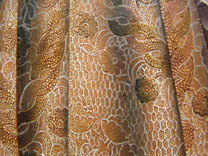
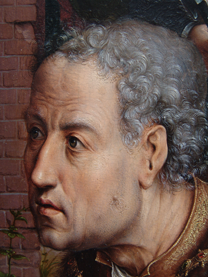
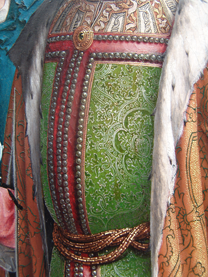
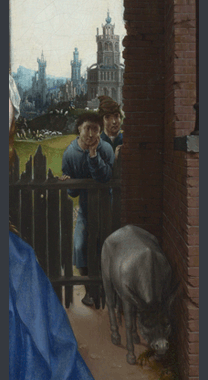
Ainsworth thought the Prague Virgin and Child types 'rather homely' and contrasted 'David's hallmark sweet Virgin and Child models'.61 The Virgin in NG2790, she observed, 'shows … David's characteristic smooth modeling of the face and refined drawing of the features in paint'.62 Indeed, if we compare the Virgin's face in NG2790 with the Virgin's head in 'The Virgin and Child with Saints and a Donor' (NG1432), attributed to David (fig.42),63 we find similarities in the painting of the eyes, nose, mouth and chin, but David's tonal contrasts are more sudden, less controlled and less delicate; the reflected lights and the highlights on the hair and the eyelids are less sensitively modulated. Ainsworth perceived in the male heads of the NG2790 'somewhat rougher brushwork and more densely applied paint'. But the heads of the three kings (fig.21), those of their attendants, even those of the foremost shepherds are just as beautifully painted as the Virgin's head, with passages of virtuoso detail that match the extraordinary precision and subtlety in the rendering of the textiles and metalwork (figs.44, 23). Even the dogs, though copied from German prints, and the ass (fig.34) are extraordinarily sympathetic studies of animals. There is nothing in Gerard David to equal Gossart's sensitivity to detail and the accomplished economy of his technique, which allowed him to record all his observations with astonishing skill.
View enlargement in Image Viewer
View enlargement in Image Viewer
View enlargement in Image Viewer
View enlargement in Image Viewer
Although Ainsworth admired Gossart's 'very sophisticated understanding of light' in his early paintings, she saw as typical of his technique during his early period a 'rather thick application of paint in discrete, unblended brushstrokes' and a 'less than subtle modeling of forms'.64 'Not yet adept at depicting the human body', Gossart is 'somewhat maladroit' in 'anatomical description, for example in the awkward foreshortening of arms'.65 She found confirmation of her attribution to David of the Virgin's head in the London 'Adoration' in her observations that his brushwork ended 'abruptly at the altered neckline of the dress, even though the light underpainting is visible beyond it. There is also a gap between the reserve left for the head and the painted layers at the right contours. This suggests that someone else executed the head of the Virgin and did not bother to blend it fully into the existing form.'66 In fact, Ainsworth may have misinterpreted the complex changes in this area, where Gossart was altering the necklines of the Virgin's chemise and dress (fig.45).