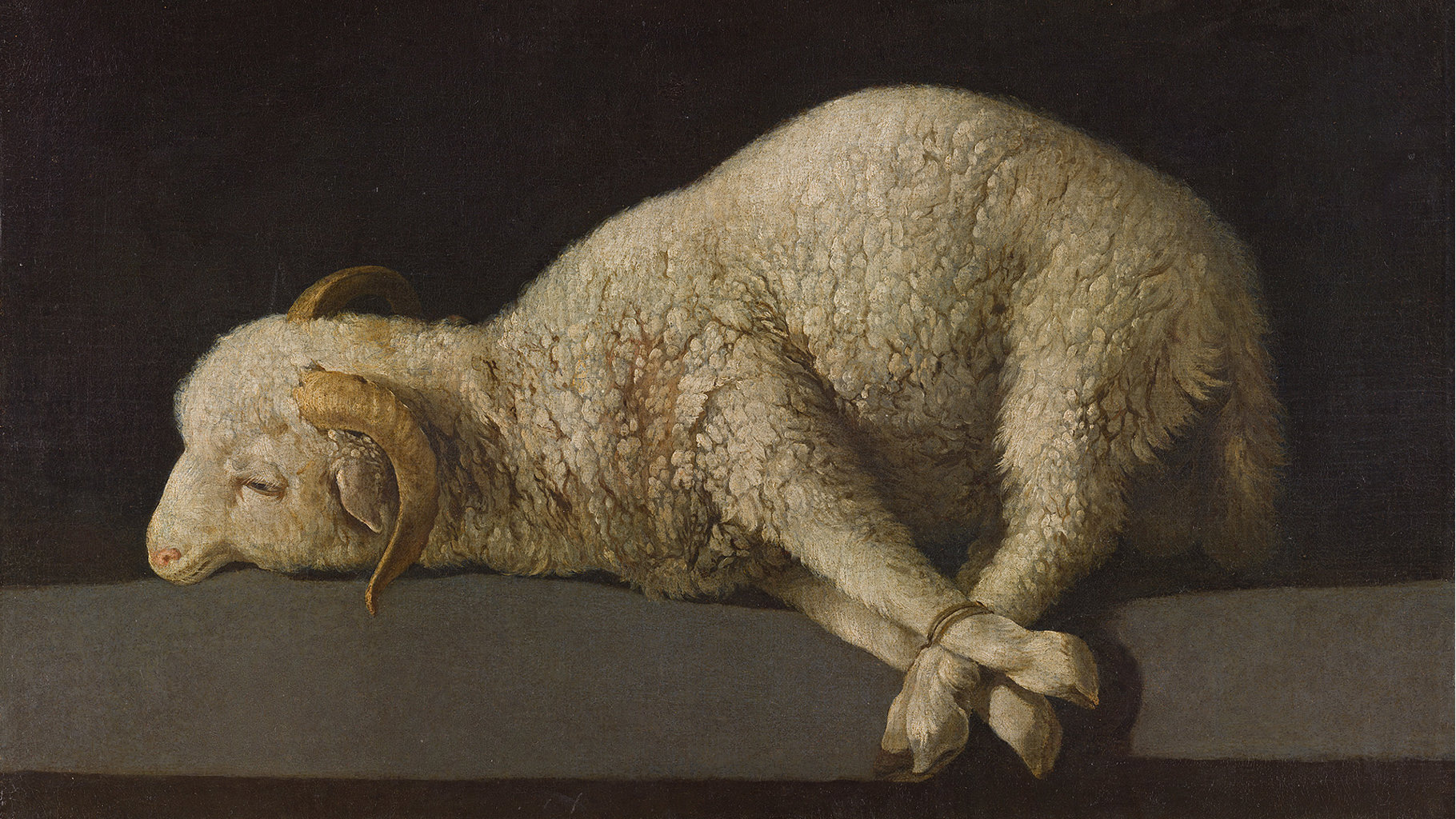
Image: Francisco de Zurbarán, 'Agnus Dei', 1635–40 Museo Nacional del Prado, Madrid © Photographic Archive Museo Nacional del Prado

2 May – 23 August 2026
Sainsbury Wing
Admission charge
The first major monographic exhibition in the UK devoted to Francisco de Zurbarán (1598–1664), will open at the National Gallery next spring (2 May – 23 August 2026).
Along with Diego Velázquez (1599–1660) and Bartolomé Esteban Murillo (1617–1682), Zurbarán was one of the leading painters of 17th-century Spain. His paintings, which include stunning life-size depictions of saints, soaring altarpieces and contemplative still lifes, are celebrated for their naturalism, directness and deep emotional power.
This exhibition of almost fifty paintings will span the chronological and iconographic breadth of the artist’s career. It will unite exceptional works from public and private collections, including the Musée du Louvre ('Saint Bonaventure on His Bier' and 'Saint Apollonia') and the Art Institute of Chicago ('The Crucifixion', 'Saint Romanus of Antioch' and 'Saint Barulas' and Juan de Zurbarán’s 'Flowers and Fruit in a Chinese Bowl'), the two partner museums to which the exhibition will travel between October 2026 and June 2027, and from the collection of the National Gallery (including Saint Margaret of Antioch and Juan de Zurbarán’s Still Life with Lemons in a Wicker Basket).
Other major loans from France ('Saint Francis of Assisi', Musée des Beaux-Arts de Lyon), Spain ('Agnus Dei' and 'The Crucified Christ with a Painter', Museo Nacional del Prado; 'Santa Casilda', Museo Nacional Thyssen-Bornemisza) and the USA ('Christ and the Virgin in the House at Nazareth', Cleveland Museum of Art; 'Still Life with Lemons, Oranges and a Rose', The Norton Simon Foundation) will complete this comprehensive exploration of Zurbarán’s career, which seeks to evoke the mystery, vision and power of his art.
Zurbarán spent most of his life in Seville, then one of the richest cities in Europe, whose maritime links to the Americas made it a hub of global trade. He painted primarily for the city’s religious orders, producing altarpieces and cycles of paintings of staggering scale and ingenuity, but also for private patrons and even, for a time in Madrid, for the king of Spain. He was also an acute observer of reality, and his still-life paintings and works for private devotion are still strikingly vivid today.
The exhibition will be divided into seven different sections: the first room will introduce the artist and explore his unique ability to inspire awe as a painter, his visionary take on the subjects he represents and his artistic particularities ('The Apparition of Saint Peter to Saint Peter Nolasco' and 'The Crucified Christ with a Painter', both from Museo Nacional del Prado).
The second room will dive into the paintings which Zurbarán produced for the many religious orders of the city of Seville ('The Vision of Alonso Rodríguez', Museo de la Real Academia de Bellas Artes de San Fernando), demonstrating the wide range of his skills as a painter of scale and narrative, and also his incredible inventiveness in the way he structured his compositions and devised iconographic solutions.
The third room, the Fabric of Saints, shows Zurbarán’s remarkable ability to represent saints as figures from our world, especially through his evocation of fabrics, drapery and textures such as wool, embroidery, leather or fine cord ('Saint Casilda', Museo Nacional Thyssen-Bornemisza; 'Saint Apollonia', Musée du Louvre). Zurbarán’s father was a haberdasher so the artist may have developed a keen interest in textiles from a young age. He was also undoubtedly inspired by the many religious processions, parades and theatrical performances that were part of the visual culture of Seville in the 17th century.
The fourth room focuses on iconography, particularly that of the Immaculate Conception, important to the religious life of Seville. Juxtaposing treatments of the same subject from different moments in his career, visitors will appreciate how Zurbarán continuously strove for new ways to evoke powerful feelings through paint.
The fifth room, Beyond Seville, looks at the paintings which Zurbarán made for patrons outside the city with which he is most closely associated. In 1634 he received the most prestigious commission of his career: an invitation to travel to Madrid and participate in the decoration of the newly built royal palace, the Buen Retiro. Zurbarán was nominated to contribute to the decoration of the Hall of Realms, an enormous room at the heart of the palace complex, some 35 metres long and 10 metres wide. To this room Zurbarán contributed 12 paintings, including a series focused on the labours of Hercules, two of which will be shown in the exhibition ('Hercules and Cerberus' and 'Hercules and the Cretan Bull', both Museo Nacional del Prado).
The sixth room displays still lifes, including four by Zurbarán’s son Juan. It is thought that Francisco de Zurbarán may not have produced more than 10 still lifes in his lifetime so this room offers visitors a rare occasion to discover some remarkable examples of this element of his art ('Still Life with Lemons, Oranges and a Rose,' The Norton Simon Foundation, shown for the first time alongside the National Gallery’s painting 'A Cup of Water and a Rose').
The last sections of the exhibition will explore the paintings Zurbarán made for private devotion and contemplation ('The Family of the Virgin', Abelló Collection) which, though often smaller in size, nevertheless pack a powerful emotional punch ('Agnus Dei', Museo Nacional del Prado; 'The Veil of Veronica', Museo Nacional de Escultura).
This exhibition is the first dedicated presentation of the artist’s paintings at the National Gallery since 1994, when the series of 'Jacob and his Twelve Sons' from Auckland Castle was shown in the Sunley Room. Several works by Zurbarán also featured in The Sacred Made Real, an exhibition held in 2009–10.
Building on existing scholarship and accompanied by a fully illustrated catalogue, Zurbarán will highlight new discoveries, reunite works from major commissions and bring together a selection of still lifes by Zurbarán and his son, Juan (1620–1649), whose small but superlative oeuvre continues to come to light.
Francesca Whitlum-Cooper, Curator of Later Italian, Spanish and French Paintings, says ‘It is thrilling to present the UK’s first major monographic exhibition on Zurbarán, which is long overdue. Whether they are 10 feet tall or small enough to hold in the hands, his paintings are extraordinarily powerful. I hope visitors in London – and at our partner venues in Paris and Chicago – will be both amazed and moved by this encounter with Zurbarán’s work’
Daniel Sobrino Ralston, the National Gallery’s CEEH (Centro de Estudios Europa Hispánica) Associate Curator of Spanish Paintings, says ‘We are excited to present the most comprehensive survey of Zurbarán’s work ever seen in Britain, bringing together exceptional loans from across the UK, Europe and the United States. This exhibition offers new insights on one of the great artists of the Baroque era, whose visionary paintings have shaped our understanding of 17th-century Spain.’
Ignacio Galán, Iberdrola and ScottishPower Chairman, says ‘In our 125th year we are honoured to help showcase in the UK one of the most celebrated painters of the 17th century. Culture and energy share a common purpose – they both illuminate lives and inspire progress. Our commitment to the arts reflects our dedication to preserving heritage and creativity. As a global business with roots in Spain, proudly working in partnership with the UK for two decades, it is fitting to support the National Gallery to bring Zurbarán to the UK for the first time in 30 years.’
Exhibition organised by the National Gallery, London, the Musée du Louvre, Paris and the Art Institute of Chicago.
The exhibition in London is curated by Francesca Whitlum-Cooper and Daniel Sobrino Ralston with Imogen Tedbury, in collaboration with Charlotte Chastel-Rousseau (Musée du Louvre) and Rebecca Long (Art Institute of Chicago).
The Musée du Louvre exhibition of Zurbarán’s works will be on view from 7 October 2026 to 25 January 2027, and the exhibition at the Art Institute of Chicago will take place from 28 February until 20 June 2027.
More information at nationalgallery.org.uk
Exhibition supported by
Headline Corporate Supporter

Fondation Socindec
The Vaseppi Trust
The exhibition’s catalogue is supported by The Elizabeth Cayzer Charitable Trust
Press view: Wednesday 29 April 2026
Image credits:
Francisco de Zurbarán
'Agnus Dei', 1635–40
Oil on canvas, 37.3 cm x 62 cm
Museo Nacional del Prado, Madrid
© Photographic Archive Museo Nacional del Prado
Publication
Title: 'Zurbarán'
Authors: Daniel Sobrino Ralston, Imogen Tedbury, Francesca Whitlum-Cooper and Rebecca Long with contributions by Ignacio Cano, Charlotte Chastel-Rousseau, Peter Cherry, Odile Delenda, Akemi Herráez Vossbrink and Benito Navarrete
208 pages, 100 illustrations, 280 × 240 mm, portrait
Hardback: £40, special Gallery price: £35
Published by National Gallery Global Ltd. Distributed by Yale University Press
The National Gallery
The National Gallery is one of the greatest art galleries in the world. Founded by Parliament in 1824, the Gallery houses the nation’s collection of paintings in the Western European tradition from the late 13th to the early 20th century. The collection includes works by Artemisia Gentileschi, Bellini, Cezanne, Degas, Leonardo, Monet, Raphael, Rembrandt, Renoir, Rubens, Titian, Turner, Van Dyck, Van Gogh and Velázquez. The Gallery’s key objectives are to care for and enhance the collection and provide the best possible access to visitors. Admission free.
Francisco de Zurbarán (1598–1664)
Between the departure of Diego Velázquez to Madrid in 1623 and the rise to prominence of Bartolomé Esteban Murillo in the 1650s, Zurbarán was the leading painter of Seville. His paintings were mostly made for Spanish religious orders. The distinctive style of Zurbarán was influenced by the realism of Caravaggio and his followers. His best work is both very direct and intensely spiritual.
Zurbarán was born in Fuente de Cantos, near Badajoz. In 1617, after training in Seville, he returned to Llerena in his native province. By 1629 he was back in Seville, where he ran an active workshop.
In 1634 he was in Madrid painting mythologies for the Buen Retiro, Philip IV’s new palace, perhaps through the intervention of his friend Velázquez. Zurbarán then returned to Seville, living there until 1658, when he once again took up residence in Madrid, where he devoted his final years to painting small-scale works for private devotion.
About Iberdrola and ScottishPower
Iberdrola, headquartered in Spain, is one of the world’s largest integrated utility companies and a global leader in electrification. Through its UK business, ScottishPower, it has invested more than £30 billion in the UK over the last 20 years and is investing a further £24bn - £18m every working day - in the UK between 2024 and 2028.
ScottishPower is the only vertically integrated energy company in the UK that operates from power to plug. With over 40 operational offshore and onshore windfarm and solar sites generating enough green electricity to power around two million homes, four regulated electricity network businesses keeping electricity flowing to around 12 million people and supplying gas and electricity to 4.2m customers, ScottishPower is helping deliver a better future, quicker.
iberdrola.com
ScottishPower.com
Also on display at the National Gallery at the same time:
Wright of Derby: From the Shadows (7 November 2025 – 10 May 2026)
Stubbs: Portrait of a Horse (12 March – 31 May 2026)
Waldmüller: Landscapes (2 July – 20 September 2026)
National Gallery Press Office on 020 7747 2865 or email National Gallery Press Office press.external@nationalgallery.org.uk
Publicity images can be obtained from https://press.nationalgallery.org.uk/
Twitter @nationalgallery
Facebook @thenationalgallery
Instagram @nationalgallery
YouTube @nationalgallery
TikTok @nationalgallerylondon
Threads @nationalgallery